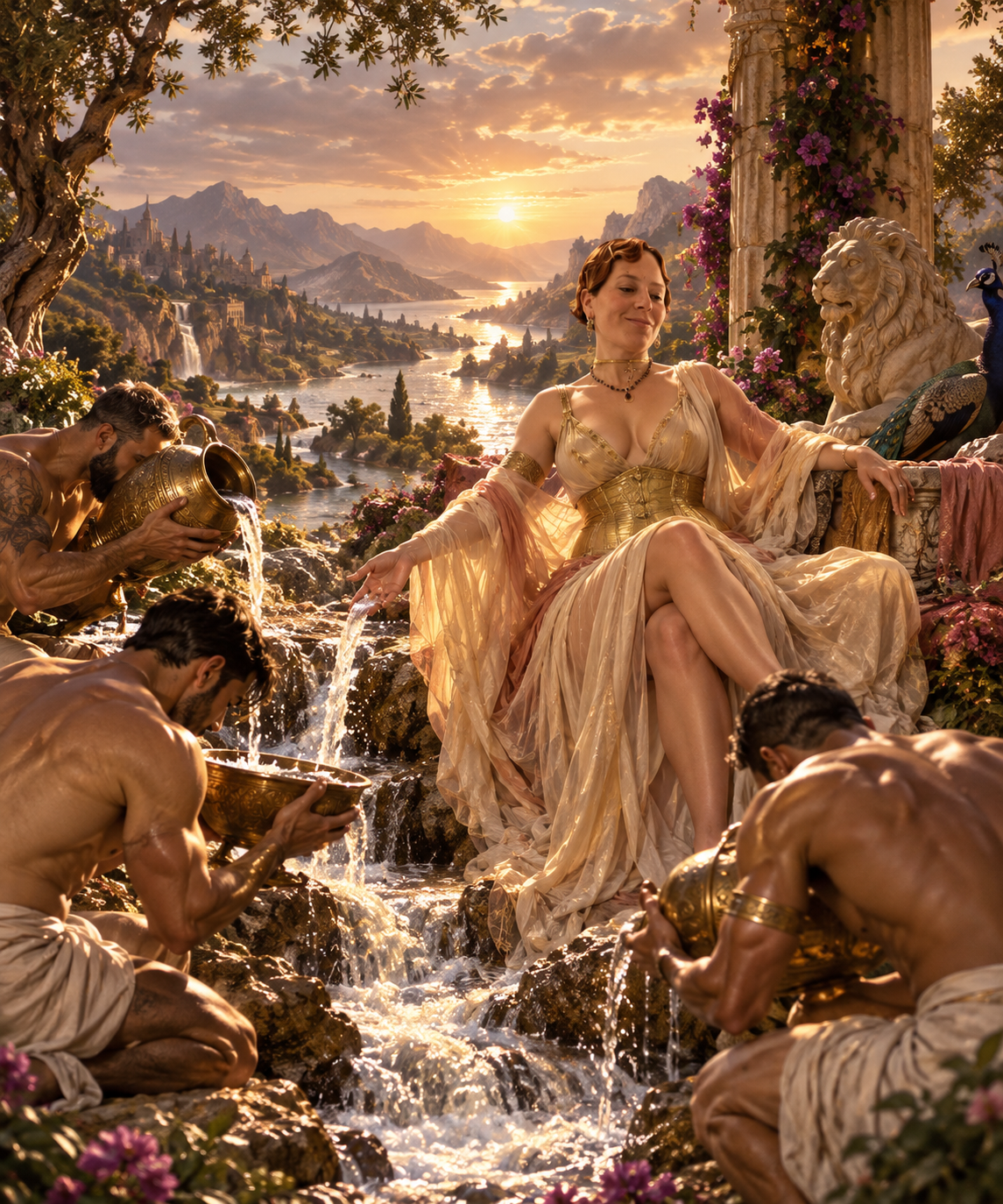
Today another piece of the language fell into place.
Patronage is gone. It never quite belonged here.
And then came Tributary Subject.
The more I sit with these words, the more perfect they become, because tribute and tributary are not pieces of poetry I have forced together. They are linguistic relatives.
Tribute comes through the Latin tributum, from tribuere: to allot, assign, bestow, give, contribute.
And tributary belongs to that same family. Before it became the word we use for a stream flowing into a larger river, it belonged to the language of tribute and contribution.
Humans did not name tribute after rivers. The rivers, of course, were here long before any of our words.
But somewhere along the way we looked at a smaller body of water pouring itself into a greater one and recognised the relationship:
A tributary renders something of itself to the greater flow.
That is what interests me.
Because perhaps one of the difficulties for the conditioned male is that patriarchy has taught him to imagine that he is the greater flow.
That everything should eventually flow toward him.
Women's attention.
Women's bodies.
Women's beauty.
Women's domestic labour.
Women's emotional labour.
Women's creativity.
The resources of the Earth.
The labour of other people.
The assumption sits so deeply inside the culture that contribution can begin to feel like deprivation.
You hear tribute and immediately ask:
What am I losing?
I want you to ask another question.
What are you feeding?
Look at the river.
A tributary does not become meaningless because it contributes its waters. It does not cease to have its own source, course or banks.
It participates.
Its waters join a larger system. Rivers replenish wetlands, irrigate land, sustain forests, animals, agriculture and human communities. Water moves through the landscape and life gathers around it.
Contribution creates fertility.
And this is where I believe our consciousness has become profoundly confused.
We have mistaken being at the receiving end of the flow for power.
We extract and call it prosperity.
We consume and call it success.
We take from bodies, communities, relationships, rivers, forests and land as though the source were inexhaustible.
And then we seem surprised when the river begins to dry.
You were never the greater flow.
Neither was I.
The greater flow is Life.
That changes everything.
Suddenly the question is no longer who gets to stand at the centre and receive.
The question becomes:
What do I contribute to the living system that sustains me?
This is what I want a man entering my world to understand.
If you receive my time, thought, creativity, attention, ritual, teaching, imagination and presence, why would it be unreasonable that something should also flow toward the source from which you are drinking?
Why should Madame prove her generosity by depletion?
Why should endless giving demonstrate the purity of my intentions, while receiving somehow contaminates them?
No.
I have lived enough of my life pouring water outward and wondering why I was thirsty.
That is not the Queendom I am building.
My Queendom must be fertile.
And fertility requires circulation.
This is why I love Tributary Subject.
A Tributary Subject is not a man being harvested by Madame.
Nor does his tribute purchase Madame's body, affection, obedience, intimacy or ownership of her time.
He is a man who has understood something more interesting.
He does not arrive at the river merely carrying an empty vessel.
He brings water.
He contributes something of himself to the greater flow.
Money may be one form of that contribution. Service may be another. Labour, skill, resources, care, consistency, attention and material support can all participate in an ecology of contribution.
Tribute is not valuable to me merely because something has changed hands.
It is valuable because it interrupts the old consciousness of extraction.
It says:
I recognise that what nourishes me must also be nourished.
I will not stand beside the river endlessly taking from it.
I participate in its continuation.
That is what Subject in Tribute begins to mean to me.
It has an old sovereign resonance, yes.
But in my Queendom, sovereignty does not mean Madame becomes the new centre of extraction.
I do not wish to reproduce patriarchy with a woman sitting on the throne.
That would merely reverse the direction of the same impoverished river.
I want something more alive than that.
The Subject remains sovereign.
Madame remains sovereign.
And both exist inside something greater than either of them.
The river.
The living system.
The greater flow.
So when you come to Madame and feel that old resistance rise at the idea of tribute, look at it.
Ask yourself who taught you that giving diminishes you.
Ask yourself why receiving another person's energy feels natural, while contributing to its replenishment feels transactional.
Ask yourself whether you have unconsciously been taught that you are the mouth of the river and everything else exists upstream for your consumption.
Then turn around.
Look upstream.
Look downstream.
Look at the whole watershed.
You are not standing outside it.
You are part of it.
And if you wish to drink from something beautiful, help keep its waters flowing.
Become tributary.
Feed what feeds you.
Bring water.
Because the river that is continually taken from will eventually run dry.
But the river that is replenished can make the whole landscape fertile.